
MEDIA RELEASE/McLaren - Photo: McLaren FB McLaren Racing can confirm that it has formally lodged…
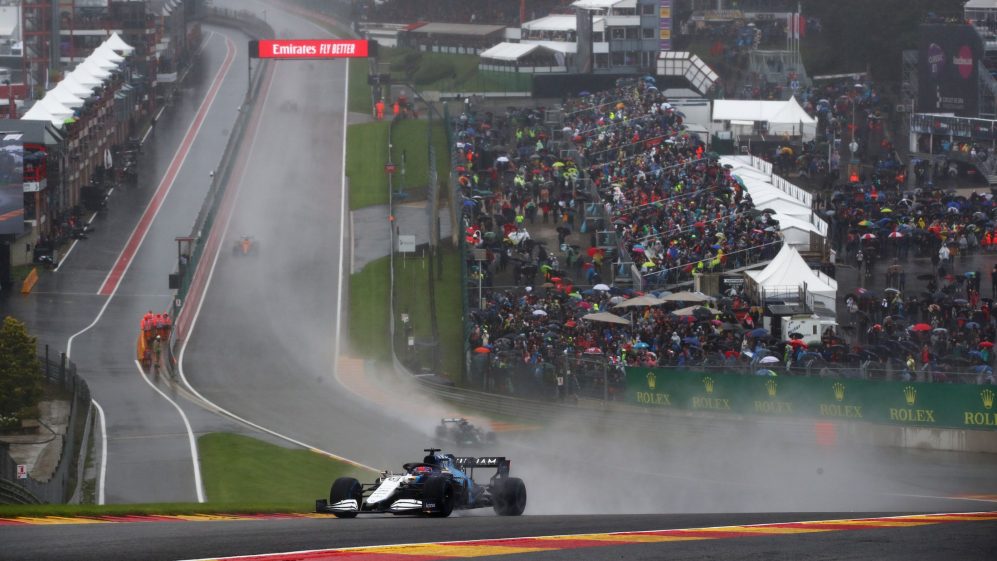
2021 BELGIAN F1 GP A CASE OF DEJA-VU? WHEN A RACE IS NOT REALLY WON AT ALL
“You can’t put the people under pressure like this. It’s a gamble. Everybody is scared to do a race when it is wet, but we are all in the same boat. We reach the point where we wait for a bad accident in these conditions before they stop the race. Maybe one day we will delay the race one hour or two.” (Alain Prost Nine World Of Sport, Australian Grand Prix 5.11.89).
As the 19 cars toured around a truly sodden Spa Francorchamps circuit on Sunday afternoon in dim light diffused by a wall of spray, most drivers were adamant that the race should not proceed. Sergio Perez had already crashed on one of his sighting laps, which brought the first of many delays, while George Russell spoke about the limited visibility.
“I can’t see anything at Turn 5. Absolutely nothing, not even Verstappen’s lights,” Russell told his engineer as he backed away from the Red Bull Honda ahead.
Max Verstappen held a different perspective from his place at the head of the grid, even though he also had to stray off line behind the Safety Car during those two formation laps.
“I think it’s wet, but it’s fine for me to race,” The Dutch driver radioed to his team.
Verstappen had everything to gain from a race start, while Lewis Hamilton and most of those behind had little to gain and everything to lose.
It was a situation that very much reminded me of the 1989 Australian Grand Prix, which I witnessed firsthand as a pitlane official.
In those days Australia represented the last leg of F1’s journey to the far outposts of the known world as the final round of the FIA Formula One World Championship.
The race took place around the streets of Adelaide and the Victoria Park racetrack. The typical street configuration was mostly framed by unforgiving concrete walls and this canyonesque feature did little to promote the dissipation of any precipitation.
1989 had been a bitter year for the sport, driven by an intense intra-team rivalry between McLaren drivers Alain Prost and Ayrton Senna. A crash at the Japanese Grand Prix between the pair and a subsequent disqualification for Senna, who had won the race, brought simmering tensions to the boil in Australia. Senna still believed that he everything to gain by winning in final race, while Prost had everything to lose.
A sustained downpour on Sunday saw Mansell and Nannini both had significant crashes in the morning warm-up session. It led to a driver stand-off just prior to the start with empty cars sitting on the grid surrounded by clusters of bemused and sodden mechanics. Alain Prost and Gerhard Berger led a driver meeting determined to postpone or cancel the Grand Prix. All bar Senna attended as the Brazilian remained strapped into the cockpit of his McLaren. All drivers eventually returned to their cars, either voluntarily or under varying degrees of coercion, with Prost declaring that he would pull into the pits at the conclusion of the opening lap.
Senna took control of the race after overcoming a fast starting teammate. Prost was true to his word and pulled out of the race at the end of the opening lap. The race was stopped a short time later after a number of incidents. After a lengthy gap the race started once more, minus Prost who refused to race. Ayrton Senna cleared out to a one minute lead as cars danced around the circuit in a series of semi-controlled slides and pirouettes, corrected by brushes with the wall.
The World Championship was finally decided on lap 14, when Senna thundered into the spray ahead and found the rear corner of Martin Brundle’s Brabham-Judd. The impact tore the left front wheel from the McLaren and ripped the rear wing from Brundle’s car.
“Just before Ayrton hit me I’d had a bloody great spin flat in sixth on the straight,” Brundle later explained (Motorsport Magazine December 1989). “The thing just got up on a puddle and round it went, twice. A complete double 360. Luckily I came out facing the right way and didn’t hit anything. After that I was taking the straight in fifth, because our biggest fear in the wet is spinning and ending up broadside to oncoming cars”.
Which is a good time to return to the 2021 Belgian Grand Prix.
Lessons learnt from races such as the 1989 AGP have led to changes in the Formula One Sporting Regulations, which includes race suspensions in circumstances deemed unsafe.
It was somewhat ironic that Martin Brundle, who now commentates for Sky Sport, was asked whether he thought the race sequence should have continued. Brundle declined to comment, citing that he had driven “In worse conditions.”
The 2021 Formula One World Championship, not unlike 1989, has become a fight between two. Lewis Hamilton currently holds a slender lead, though Verstappen’s pole position had placed him in a better point scoring position at Spa. A decision to cancel the Grand Prix would be to Hamilton’s advantage, whereas a race of any length would promote Verstappen’s cause.
So, for almost three hours, everyone waited. Drivers changed into dry race suits, teams did what they could, race control hovered over satellite images for a possible break in the weather as fans draped in plastic huddled for cover under umbrellas.
“It’s hard because you try to stay alert in case you get a call, but you don’t want to use all your energy,” Ricciardo explained to Sky Sport after initiating a Mexican Wave in the grandstands that lined the Pit Straight. “So I’m just trying to stay alert enough, but I’m at that point now where I’m a bit bored. I really don’t know what to do.”
Race Control then gave the directive for the race to commence behind the Safety Car. For almost two laps Max Verstappen lead a single file of F1 cars around the 7 kilometres of racetrack in conditions that had deteriorated once more. The call was then made to red flag the race for a second and final time. Max Verstappen declared the winner from Russell and Hamilton. The top 6 remained in qualifying order, while the remainder gained a place courtesy of Perez’s accident. Perez did get back on the track after repairs were made to his Red Bull Honda to be classified in 20th.
“It is always good to win and the points are important but today is not how anyone wants to do it, especially on our 50th start with Honda,” Verstappen said to Red Bull Media. “In hindsight it was very important to get pole yesterday and although it’s a big shame not to do some proper racing laps, as I really love coming to this track, it was just impossible in these conditions. I thought maybe at 15:30 the conditions were a bit better than just now when we tried to re-start but the visibility was still very low and I understand why we couldn’t race today. For me in the lead the visibility was a lot better, even with the Safety Car ahead, but the guys behind me couldn’t see a single thing and if someone went off at Eau Rouge and bounced back onto the track they could have been T-boned at high speed which we do not want.”
MORE MOTORSPORT NEWS…
SUBSCRIBE TO VELOCITY MAGAZINE
For all our news keep your eyes peeled on the Velocity Magazine website and social media, Facebook, Twitter and Instagram for our daily updates and to get the latest edition of our glossy magazine subscribe here from just $55 for 12 months subscription.
GET OUR LATEST ISSUE NUMBER 40 HERE


Related Posts
This Post Has 0 Comments